
I’ve often heard beginner production students question the need for music theory knowledge, and while you can get pretty far without basic their skills, understanding the fundamentals will help you to craft more compelling music more quickly than if you had no idea what you were doing from a theory standpoint.
Music theory can seem a bit intimidating, but at the end of the day, for music producers theory is not about memorizing strict rules like you find in jazz and classical theory, but instead is geared towards understanding rhythmic patterns, relationships between keys, building and releasing tension, chord and arrangement structure, scales, etc so that you can make stronger creative decisions more quickly when you’re in the flow.
Regardless of the genre that you primarily produce, a solid understanding of music theory can dramatically improve your songwriting, melodies, chord progressions, basslines, and arrangements.
In this guide, I’ll take you though the most essential music theory concepts every producer should know, including:
- Notes and scales
- Intervals
- Chords
- Chord progressions
- Rhythm and timing
- Melody writing
- Bassline relationships
- Song structure
- Ear training
- Practical applications inside your DAW
By the end of this article, you’ll have a strong foundation you can immediately apply to your productions.
Why Music Theory Matters for Producers
Many successful producers learn by ear, experimentation, and imitation. While that approach works well for a while, theory helps accelerate the learning process and helps you to avoid hitting a creative wall in the studio where you can’t figure out why things aren’t sounding the way you want them to.
Instead of guessing which notes work together, you can begin to understand why certain combinations sound emotional, energetic, dark, uplifting, tense, or resolved.
Music theory helps producers:
- Write stronger melodies
- Create emotional chord progressions
- Finish tracks faster
- Communicate with collaborators
- Analyze songs they love
- Avoid clashing notes
- Build better basslines
- Create intentional tension and release
- Improve arrangement decisions
Theory is best viewed as a creative toolkit rather than a set of restrictions, especially within the context of EDM production.
Understanding Notes
Most of the music we’re familiar with today is created using Western tonal music theory, which is built from 12 notes:
- C
- C#/Db
- D
- D#/Eb
- E
- F
- F#/Gb
- G
- G#/Ab
- A
- A#/Bb
- B

After B, the cycle repeats again at a higher pitch. This is what’s known as an octave. So this same series of 12 notes continually repeats in either higher or lower octaves.
On a piano roll inside your DAW, these notes repeat vertically across octaves. Most DAWs include a piano keyboard graphic to the left of the piano roll to help you know what MIDI note you’re inputting as it relates to the keyboard. Learning this repeating pattern is one of the first major steps in understanding music theory.
The pitch of a note is determined by how many cycles per second it oscillates, a number that is expressed in Hertz (Hz). An octave occurs when one note vibrates at double the frequency of another. For example:
- A2 = 110 Hz
- A3 = 220 Hz
- A4 = 440 Hz
Even though these pitches are higher or lower, we perceive them as versions of the same note.
Half Steps and Whole Steps
Your content goes here. Edit or remove this text inline or in the module Content settings. You can also style every aspect of this content in the module Design settings and even apply custom CSS to this text in the module Advanced settings.
The distance between notes is called an interval, or a step.
The smallest interval in Western music is a half step (also called a semitone). When looking at a piano keyboard, a semitone is created when two keys are right next to each other, whether that’s a black key and a white key, or two white keys. As long as the keys/notes are directly next to each other, that’s a semitone or half step.
For example:
- C → C#
- E → F
- B → C

A whole step equals two half steps. So on a keyboard you’d count up or down two keys from the note you’re playing to find the whole note.
For example:
- C → D
- F → G
- A → B

Understanding half steps and whole steps is critical because scales and chords are built from specific interval patterns.
Major Scales
The major scale is one of the most important foundations in music theory.
The interval pattern for a major scale is:
W−W−H−W−W−W−H
(W = whole step, H = half step)
Using this pattern, we can build a C Major scale:
- C
- D
- E
- F
- G
- A
- B

Then back to C, the octave.
C Major is especially useful for beginners because it contains only white notes on a piano keyboard, making it easier to understand the relationships between notes and also to play live.
Major scales are generally described as sounding brighter, happier, and more uplifting. Many pop and house tracks heavily rely on major tonalities.
Minor Scales
Minor scales are equally important in electronic music production.
The natural minor scale pattern is:
W−H−W−W−H−W−W
An A Minor scale contains:
- A
- B
- C
- D
- E
- F
- G

Interestingly, A Minor uses the exact same notes as C Major. This is because A minor is the relative minor of C major. A relative scale is a scale that uses the same notes of a different scale. Each major scale has a relative minor, and vice versa.
Minor scales often sound:
- Emotional
- Dark
- Melancholic
- Aggressive
- Cinematic
A huge amount of modern electronic music is written in minor keys because of their emotional flexibility.
What Is a Key?
A key is the tonal center of a song.
When a track is “in A Minor,” it means:
- A acts as the tonal home
- The melodies and chords primarily use notes from the A Minor scale
- Musical tension typically resolves back to A
Understanding keys helps avoid dissonance and keeps your melodies, chords, and basslines working together cohesively.
Ableton now includes a scale highlighting features in the piano roll, which can help producers of all levels stay in key while composing. Despite having a solid understanding of theory, I often like to produce with the scale highlight on, just to move quickly and immediately see which notes I have available to use.
Intervals
As mentioned earlier, intervals describe the distance between two notes. But each of these intervals have names.
Some important intervals include:
| Interval | Example | Emotional Character |
| Minor 2nd | C → Db | Tension |
| Major 2nd | C → D | Open |
| Minor 3rd | C → Eb | Sad |
| Major 3rd | C → E | Happy |
| Perfect 5th | C → G | Powerful |
| Minor 7th | C → Bb | Jazzy |
| Octave | C → C | Stable |
The emotional quality of music largely comes from interval relationships.
For example:
- Minor thirds often sound emotional or dark
- Perfect fifths sound stable and powerful
- Minor seconds create tension and dissonance
Understanding intervals improves melody writing and chord construction dramatically.
Building Chords
Chords are groups of notes played simultaneously.
The most common chords are triads, which contain three notes:
- Root (so if we’re playing a C Major chord the root is C)
- Third (the third for the C Maj is found by counting up 4 keys/notes from C, not including C. You should arrive at an E)
- Fifth (the 5th is found by counting up from C 7 steps/semitones. You should arrive at a G)
Lots of my students find it helpful to picture the triad as a number of steps to count up from the root, so in the case of the C Major chord, that would be 4 steps to find the 3rd of the chord, and 7 steps to find the 5th.
The minor triad is very similar to the major chord, except that the third is lowered a half step, so in the key of C minor, the third is Eb instead of E, and the numbers that you count up from the root are 3 and 7
C Major chord:
- C
- E
- G

C Minor chord:
- C
- Eb
- G

Diatonic Chords
Diatonic simply means “in the key.” if you’re playing a song in the key of C Maj and you use only the notes of the C Major scale, you’re playing diatonically.
If you build a triad on each note of a scale using only diatonic notes, you get the following series of chords:

In C Major:
| Scale Degree | Chord |
| I | C Major |
| ii | D Minor |
| iii | E Minor |
| IV | F Major |
| V | G Major |
| vi | A Minor |
| vii° | B Diminished |
These chords work naturally together because they all come from the same scale.
When expressing major vs minor chords using Roman Numerals like you see above, usually major chords are expressed as upper case letters and minor/diminished chords are expressed as lower case letters. This is not very important to most producers though, as you probably won’t be doing much written analysis in your studio sessions.
Common Chord Progressions
Chord progressions are sequences of chords played back to back.
Some progressions appear constantly across modern music because they create satisfying emotional movement.
I–V–vi–IV
In C Major:
- C
- G
- Am
- F

This progression appears in countless pop songs.
It feels:
- Emotional
- Familiar
- Uplifting
vi–IV–I–V
In C Major:
- Am
- F
- C
- G

This progression is extremely common in EDM and melodic bass music.
It creates a more emotional atmosphere while still feeling energetic.
i–VII–VI–VII
In A Minor:
- Am
- G
- F
- G
This darker progression is common in cinematic, trap, dubstep, and techno styles.
Chord Extensions
Once basic triads feel comfortable, producers often add extra notes called extensions. An extension is just an extra note (or several) added to the top of the top of the chord to create a thicker, more interesting sound.
Examples include:
- 7ths (adding 1 note to the triad)
- 9ths (adding 2 notes to the triad)
- 11ths (adding 3 notes to the triad)
- 13ths (adding 4 notes to the triad)
A Cmaj7 chord contains:
- C
- E
- G
- B

These extensions create richer emotional textures.
House, jazz, lo-fi, future bass, and neo-soul frequently use extended harmony.
Rhythm and Timing
When we think of music theory we usually think of scales and chords, but rhythm is equally important.
Most modern music uses a 4/4 time signature, meaning:
- 4 beats per measure
- Quarter note receives one beat
Kick drums in house music often hit on every quarter note:
1
2
3
4
Meanwhile, snares commonly land on beats 2 and 4.
Hats are a little bit more freeform in terms of what you can do with them rhythmically, but generally if you place the hats every 1/8th note (that’s twice every beat or quarter note) that’s a good place to start.
Understanding rhythmic subdivisions is critical for groove creation.
Note Lengths
Common rhythmic divisions include:
| Note Type | Length |
| Whole Note | 4 beats |
| Half Note | 2 beats |
| Quarter Note | 1 beat |
| Eighth Note | 1/2 beat |
| Sixteenth Note | 1/4 beat |

Each measure contains:
1 Whole Note
2 Half Notes
4 Quarter Notes
8 Eighth Notes
16 Sixteenth Notes
Most electronic music relies heavily on eighth and sixteenth note subdivisions.
Faster subdivisions create more rhythmic density and energy.
Swing and Groove
Often we like to add a little bit of imperfection to our rhythms. When notes or drums fall directly on each subdivision of the beat, that’s what we call Quantized. Perfectly quantized rhythms can sound robotic and inhuman, and sometimes can get a bit boring. In this case we can add swing.
Swing shifts rhythmic timing slightly to create a more human feel. For example, when you’re working with an 8th note hat pattern, you’ll take the second, fourth, sixth, etc. hat and delay it by a few milliseconds (anywhere from 10-40ms depending on how hard you want it to swing) to cause them to swing.
Many genres rely heavily on groove:
- Hip-hop
- House
- Garage
- Funk
- Lo-fi
- Drum & Bass
Small timing adjustments can dramatically affect the emotional feel of a track.

Often we like to add a little bit of imperfection to our rhythms. When notes or drums fall directly on each subdivision of the beat, that’s what we call Quantized. Perfectly quantized rhythms can sound robotic and inhuman, and sometimes can get a bit boring. In this case we can add swing.
Swing shifts rhythmic timing slightly to create a more human feel. For example, when you’re working with an 8th note hat pattern, you’ll take the second, fourth, sixth, etc. hat and delay it by a few milliseconds (anywhere from 10-40ms depending on how hard you want it to swing) to cause them to swing.
Many genres rely heavily on groove:
- Hip-hop
- House
- Garage
- Funk
- Lo-fi
- Drum & Bass
Small timing adjustments can dramatically affect the emotional feel of a track.
Melody Writing
Melodies are one of the most recognizable parts of a song. I usually call a melody the “face” of the track when working with my students.
Strong melodies often:
- Use repetition (not too little, not too much)
- Include variation (again, not too little, not too much)
- Balance tension and resolution
- Follow chord tones
- Use memorable rhythms
A useful beginner technique is emphasizing chord tones during strong beats.
For example:
If the chord is C Major:
- C
- E
- G
These notes will usually sound the most stable and you’d gravitate towards using these notes on strong beats of the measure, which are, listed in order from strongest to least strong: 1, 3, 2, and 4.
You don’t always have to stick to chord tones though. Non-chord tones create tension and movement in a melody.
Motifs
A motif is a short repeating musical idea. Many iconic melodies are surprisingly simple, and one of the most common issues I encounter with my students when trying to write effective melodies is that they tend to get too complicated.
Instead of writing long complicated phrases, try:
- Repeating a small idea
- Changing the rhythm
- Changing one note
- Moving the motif to different pitches
This creates cohesion and memorability while still providing a little bit of variation for interest.
Basslines
Basslines connect rhythm and harmony.
The bass often reinforces the root note of the current chord.
Example:
|
Chord |
Bass Note |
|
Am |
A |
|
F |
F |
|
C |
C |
|
G |
G |
However, more advanced basslines may:
- Use passing tones (a passing tone is a note that is not included in the chord, and usually you don’t want to hang out on these too long before moving to a chord tone)
- Use octaves
- Add rhythmic syncopation
Electronic genres often prioritize rhythm and groove in bass design just as much as harmony.
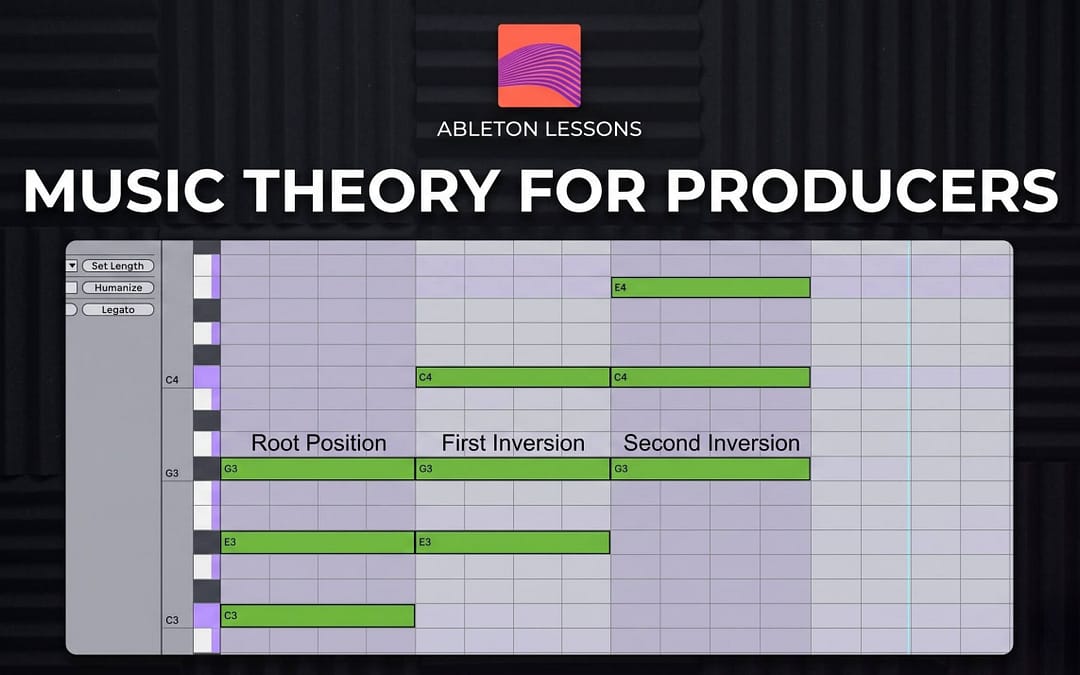
Chord Inversions
An inversion changes which note is lowest in a chord.
Example:
C Major root position:
- C
- E
- G
First inversion:
- E
- G
- C
Second inversion:
- G
- C
- E

Inversions help create smoother movement between chords, as you can rotate the octave that the notes are presented in in a chord to avoid large jumps when moving to the next chord. This technique is extremely important for polished-sounding chord progressions.

Tension and Resolution
Music constantly alternates between tension and release.
This emotional push-and-pull creates excitement.
Tension can come from:
- Dissonant intervals (non chord tones)
- Rhythm (increasing rhythmic speed conveys more urgency/tension)
- Automation
- Risers
- Drum fills
Tension wants to resolve, and resolution occurs when the music returns to stability.
Many producers instinctively create tension with arrangement techniques, but theory helps explain why those moments work emotionally.
Practical Music Theory Tips Inside Your DAW
Use Scale Highlighting
Most DAWs, including Ableton, allow you to highlight notes in a chosen scale. This helps avoid accidental dissonance while learning.
Analyze Songs You Love
This is crucial! I have all my students analyze lots of music, it’s one of the best ways to learn what works in tracks you love. I highly encourage you to import reference tracks and study:
- Key
- Chord progression
- Melody shape
- Arrangement
- Bass movement
This is one of the most effective ways to internalize theory.
Start Simple
Many beginners tend to overcomplicate things, but often simplicity is best.
Some of the best songs ever written use:
- 4 chords
- Simple melodies
- Repetition
- Strong rhythm
Complexity does not automatically create emotional impact.
Learn Functional Roles
Different instruments serve different theoretical purposes:
- Drums = rhythm
- Bass = harmony + rhythm
- Chords = harmonic foundation
- Melody = lead song identity
Understanding these roles improves mixing and arrangement decisions too.
Music Theory Is a Tool, Not a Rulebook
One of the biggest misconceptions about music theory is that it limits creativity. In reality, theory simply describes patterns humans already find emotionally effective. I tell all my students that they are always free to break theoretical conventions.
Many incredible songs intentionally use:
- Dissonance
- Unexpected chords
- Out-of-key notes
- Polyrhythms
- Atonality
Theory helps you make these decisions intentionally instead of accidentally.
Final Thoughts
Music theory is one of the most valuable long-term investments a producer can make. You do not need a formal music education or years of classical training to benefit from it. Even understanding a few foundational concepts can dramatically improve your songwriting, sound design, arrangement, and overall musical confidence.
The key is applying theory practically inside your productions rather than treating it like abstract academic information.
Don’t try to figure it out all at once, take it one step at a time:
- Learn scales
- Build simple chords
- Practice writing melodies
- Analyze songs you love
- Experiment constantly
Over time, your ears will develop, your instincts will improve, and theory will begin feeling less like “rules” and more like creative intuition.
The producers who grow the fastest are usually the ones who combine experimentation with understanding. Music theory gives you the framework, but your creativity gives the music personality.